Bhadla: 2,245 MW on 14,000 acres
One of the world's largest solar parks sits in one of India's most inhospitable deserts — and what it proves about scale is more useful than any superlative.
What the site is
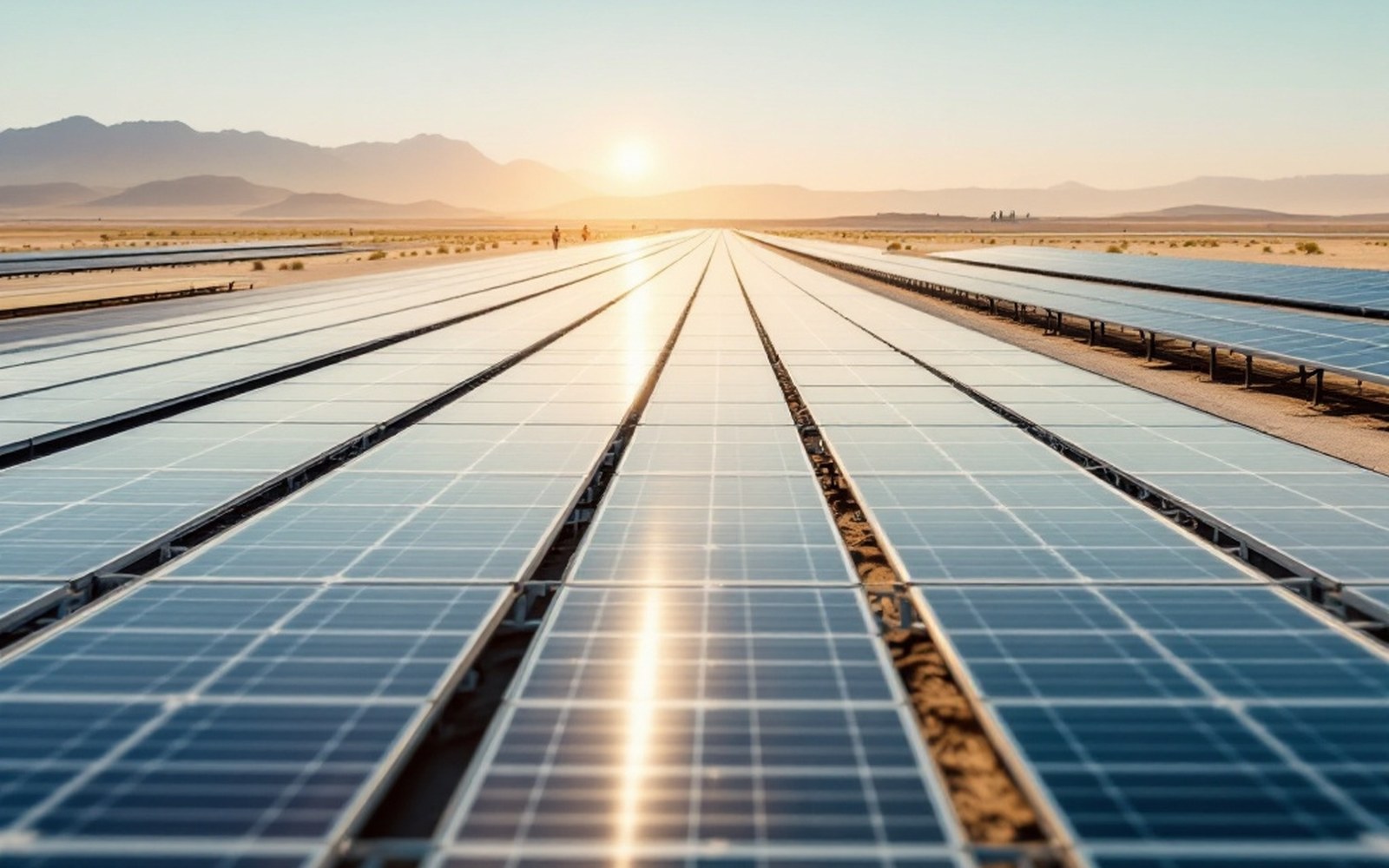
Bhadla is a village in the Thar Desert of Rajasthan, roughly 200 kilometres north of Jodhpur. The terrain is flat, bone-dry and brutal: summer temperatures exceed 50 °C, sand encrusts everything, and annual rainfall is under 200 millimetres. These same conditions make it exceptional for solar generation — irradiance levels run consistently above 5.5 kWh per square metre per day, and the site's capacity factor outperforms most European installations by a wide margin.
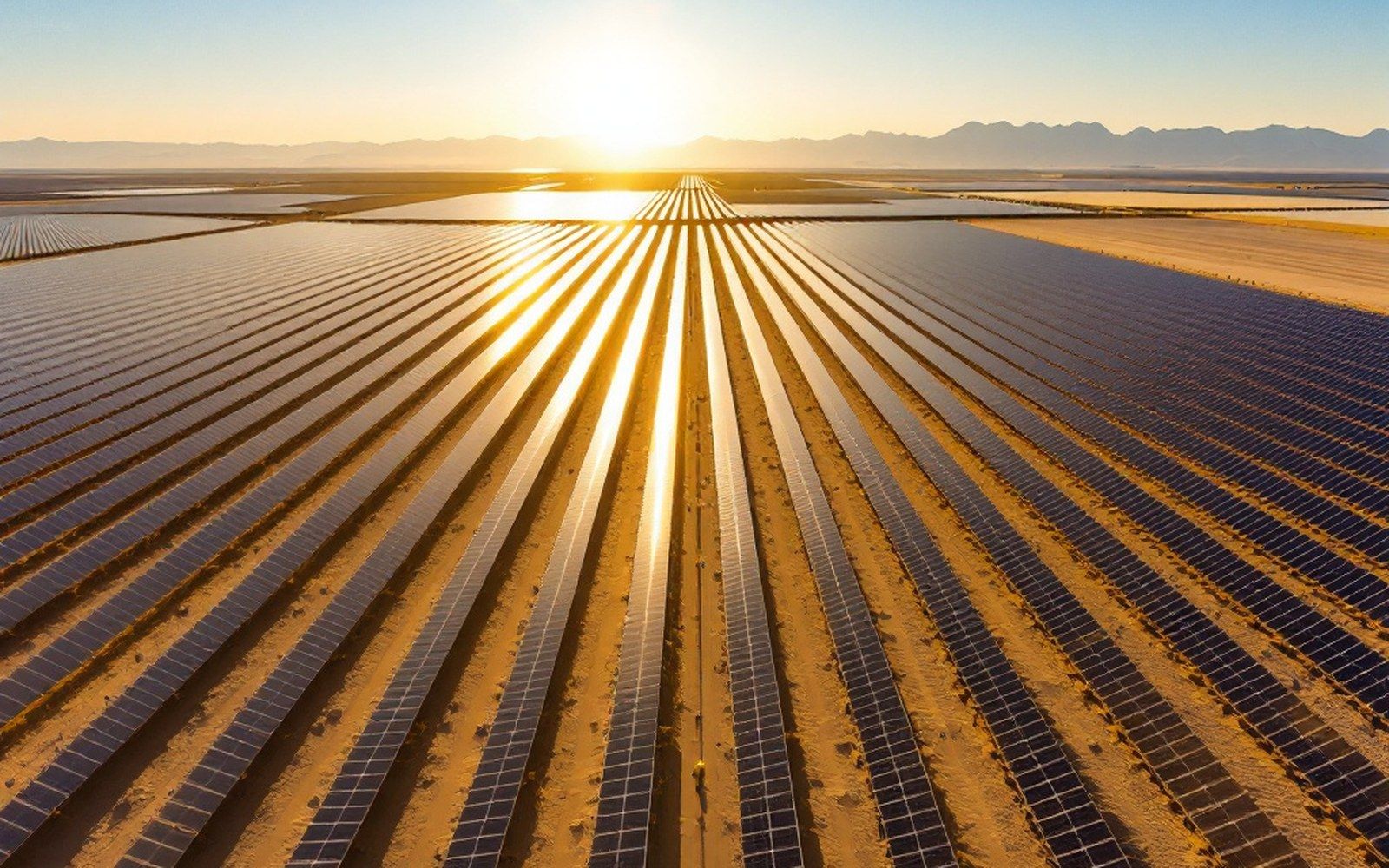
The park's total installed capacity reached 2,245 MW across four phases completed between 2018 and 2020, spread over approximately 14,000 acres — around 56 square kilometres. At that scale, the geometry becomes almost abstract. India's Ministry of New and Renewable Energy records it as the country's largest solar installation, and it is broadly recognised as one of the largest single-site arrays in the world.
What 14,000 acres of panels looks like
Roughly ten million panels occupy the site, arranged in rows across the sand. The rows are not tightly packed: spacing is determined by the need to avoid one row shading the next at low sun angles, and by the turning radius of the cleaning vehicles that move between them. That spacing pushes the land footprint well beyond what the panels alone would suggest.
The panels themselves are polycrystalline and monocrystalline silicon modules mounted on fixed-tilt frames oriented south, set at an angle calculated for Rajasthan's latitude. Some sections use single-axis trackers, which follow the sun through the day and raise energy yield by roughly 15–25 percent at the cost of greater mechanical complexity. Dust is a constant operational concern — the Thar generates sandstorms that can cut output by a measurable fraction within hours. Cleaning is not optional here; it is a scheduled, logistics-intensive activity run across the whole site.
Roughly ten million panels occupy the site, arranged in rows across the sand.
Transmission infrastructure is visible at the same scale as the panels. Bhadla connects to the Indian national grid through multiple high-voltage substations on site, feeding into lines capable of moving power toward load centres in Delhi and beyond. The site's developer base is not a single company: multiple independent power producers hold different zones within the park, including NTPC, Adani Green Energy and ReNew Power, among others, each operating under long-term power purchase agreements.
What the numbers mean
The 2,245 MW figure is peak DC nameplate capacity. Actual annual generation is a function of the capacity factor, which at Bhadla runs in the range of 24–28 percent depending on the zone and tracking configuration — meaning the park delivers something in the range of 4,700 to 5,500 GWh per year across the whole site. To put that in one frame of reference, it is broadly equivalent to the annual output of a 600 MW coal plant running continuously.
The auction prices that filled Bhadla's later phases became a reference point for how far the solar learning curve had moved in India. In 2018, capacity auctioned within the park cleared at tariffs below ₹2.50 per kWh — figures that would have been implausible five years earlier. Those results pulled the Indian benchmark down and set the terms for subsequent competitive tenders across the country.
Bhadla is also a demonstration of what land use at this scale requires institutionally: coordinated state land acquisition, grid planning years ahead of first power, and regulatory frameworks that could handle multiple concurrent developers in a single geographic zone. IRENA's renewable capacity statistics track India's aggregate solar growth, within which Bhadla is the single largest contributor from one location. The site is not a prototype. It is in production, and has been for several years.