Al Dhafra and the 1.35-cent contract
The site is flat, dry and sun-baked eleven months of the year. The contract signed there in 2020 is the lowest price ever recorded for utility electricity.
What was bid, and where
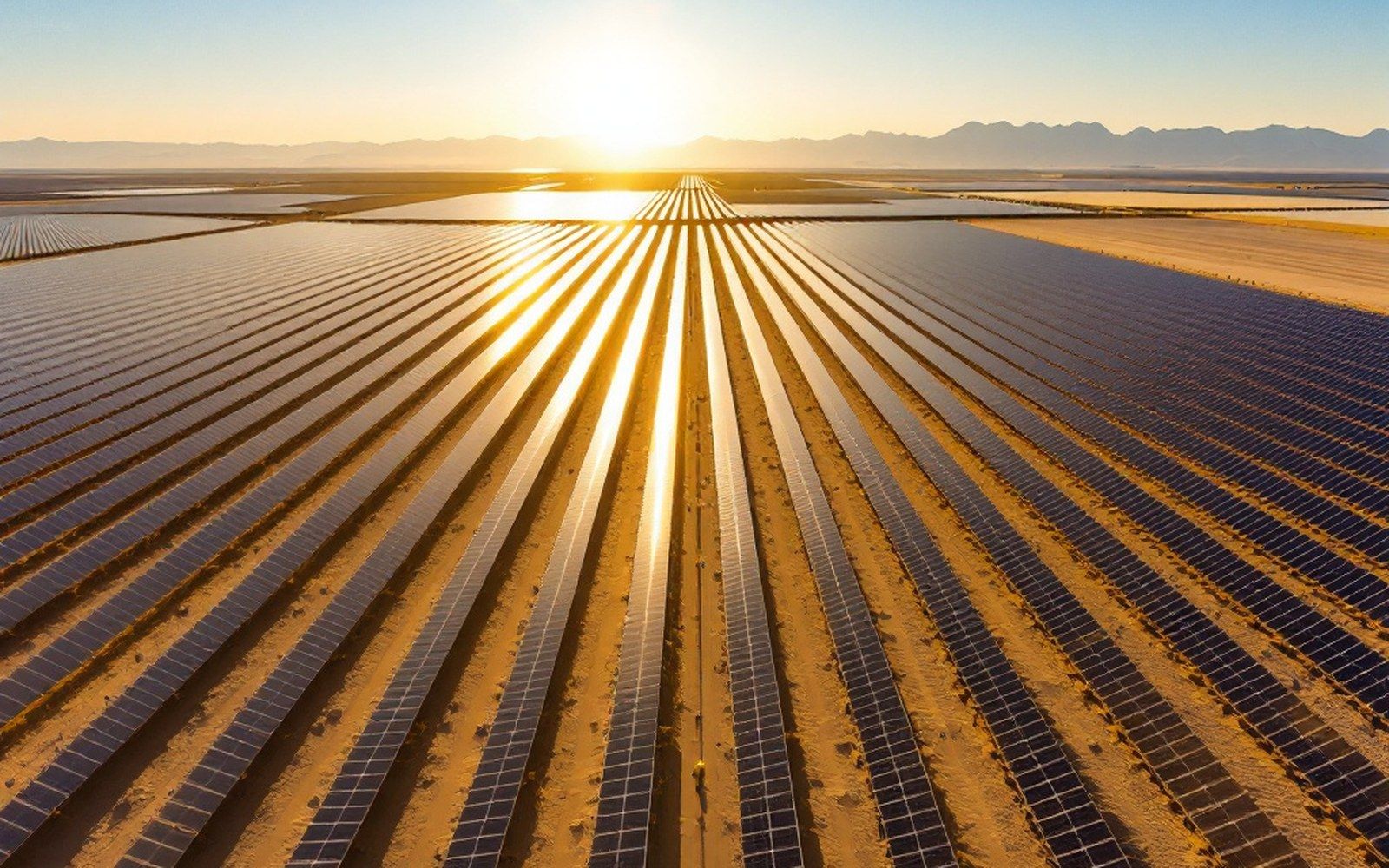
In July 2020, a consortium of EDF Renewables and Jinko Solar submitted a tariff of $0.01353 per kilowatt-hour for a power purchase agreement covering the Al Dhafra solar project, located roughly 35 kilometres south of Abu Dhabi city in the United Arab Emirates. The Emirates Water and Electricity Company, Abu Dhabi's state offtaker, took the contract. When completed, Al Dhafra was designed to supply 2,000 megawatts to the Abu Dhabi grid: at the time of its award, the largest single-site photovoltaic project ever contracted anywhere.
The bid broke the previous record set in an earlier auction, which had itself broken a record set in Portugal a year before that. The price trajectory these successive auctions trace is not noise; it is the solar learning curve working in real time, compressing the cost of electricity at a pace no other generation technology has replicated in the same period.
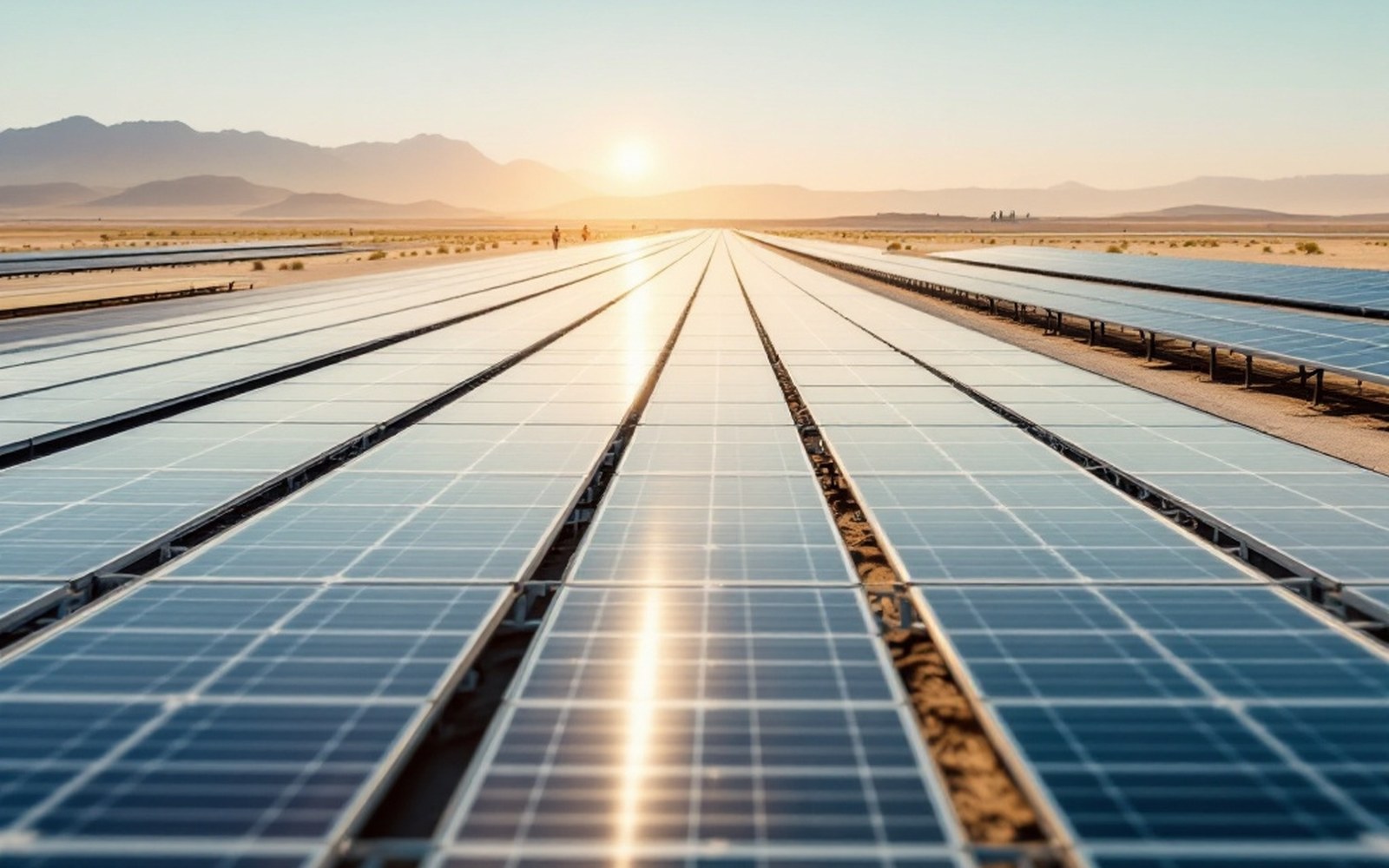
Al Dhafra's first power reached the grid in 2022, with full commissioning following in stages. The installed array covers approximately 20 square kilometres of desert southwest of Abu Dhabi city, and its panels — around 4 million of them — are mounted on single-axis trackers that tilt east in the morning and west in the afternoon, adding several percentage points to annual yield compared with a fixed-tilt installation.
The conditions behind the number
A price does not emerge from nothing. The 1.35-cent figure reflects at least five distinct physical, financial and geographic conditions that stacked on top of one another at Al Dhafra, and removing any one of them would have moved the number upward.
Irradiance. Abu Dhabi sits at roughly 24 degrees north latitude with a hot-desert climate. Direct normal irradiance across the emirate averages well above 2,000 kilowatt-hours per square metre per year — among the highest in the world for a location with existing grid infrastructure and a creditworthy offtaker. The capacity factor achievable at Al Dhafra is substantially higher than what the same hardware would produce in central Europe or the mid-Atlantic United States. A solar plant that runs at a higher capacity factor spreads its fixed capital cost across more kilowatt-hours, and that arithmetic alone explains a large part of the gap between what a panel costs to install and what electricity from it costs to produce.
Land. The plot is flat desert, state-owned and available for development without displacement, litigation or significant remediation. Land acquisition costs, which can be a meaningful fraction of project cost in densely settled or legally complex jurisdictions, were effectively zero. The terrain requires no grading.
Financing. The project was structured with Abu Dhabi government entities as counterparties on a long-term power purchase agreement. From a lender's perspective, a 25-year contract with a sovereign-backed buyer is as close to a risk-free cash flow as a renewable project can offer. Low perceived risk means low cost of capital; the International Energy Agency has consistently documented that financing costs account for a larger share of solar LCOE than almost any other variable — often larger than the hardware itself. Abu Dhabi's credit quality compressed that component dramatically.
Irradiance. Abu Dhabi sits at roughly 24 degrees north latitude with a hot-desert climate.
Module cost. The hardware procured for Al Dhafra was sourced at the bottom of a global module cost curve that, by 2020, had already fallen more than 90 percent from 2010 levels. Jinko Solar, as co-developer and supplier, brought panel costs that were well under $0.20 per watt — a price point that would have been inconceivable fifteen years earlier. Fraunhofer ISE tracks this curve systematically; the data shows that every doubling of cumulative global production has brought module costs down by roughly 20 to 23 percent.
Scale. At 2,000 MW, Al Dhafra is large enough that balance-of-plant costs — cabling, inverters, substations, project management — are spread across an enormous base of installed capacity. Engineering work that costs roughly the same whether the project is 200 MW or 2,000 MW becomes nearly invisible in the per-kilowatt-hour math at the upper end of that range. Bhadla in Rajasthan deployed the same logic across 14,000 acres, reaching over 2,245 MW from a similar flat-desert starting point.
These five factors are not uniformly reproducible. A project developer trying to replicate the Al Dhafra number in a cloudier location, on privately owned land, backed by a less creditworthy offtaker, with a smaller total capacity and without a vertically integrated equipment supplier would find the number climbing quickly past two cents, then three. The record matters as a demonstration of where the floor sits under the best conditions; it does not mean generation from solar is universally available at that price.
What the number does and does not mean
The 1.35-cent tariff is a contracted price for the electricity delivered over the agreement's lifetime, not a spot price, a marginal cost figure or a levelised cost estimate derived from modelling. It is a real number that a real buyer agreed to pay a real seller. That distinction matters because it makes the figure harder to dismiss than an analyst's projection.
What it does not capture is the system cost of integrating 2,000 MW of variable generation into a grid. Al Dhafra produces power when the sun shines — broadly, from mid-morning to late afternoon, with the peak arriving around solar noon. The Abu Dhabi grid carries substantial air-conditioning load through the day, which means the production profile and the demand profile align unusually well compared with temperate climates where industrial load runs around the clock and cooling demand is modest. That coincidence of peak supply and peak demand softens the integration challenge and is itself a geographic advantage baked into the 1.35-cent figure.
Beyond the peak hours, the grid still requires dispatchable capacity — gas turbines in Abu Dhabi's case — that Al Dhafra cannot replace. The cost of that capacity is real, paid for elsewhere in the system, and does not appear in the solar tariff. IRENA's renewable power generation costs data makes clear that as variable renewable penetration increases, integration costs rise in ways that are not reflected in individual project auction results.
None of that diminishes the engineering reality that Al Dhafra represents. The project demonstrated that under the right geographic, financial and structural conditions, solar photovoltaic generation can be contracted at a price below any other electricity source in recorded history — not as a modelled result, not as a subsidy artifact, but as a real exchange between buyer and seller in 2020, at a scale of two gigawatts, in a desert south of Abu Dhabi.