Where the containers are
A battery installation is a yard of containers, a transformer and a fence — and it ends up where the grid wants it, not where anyone planned.
What it looks like
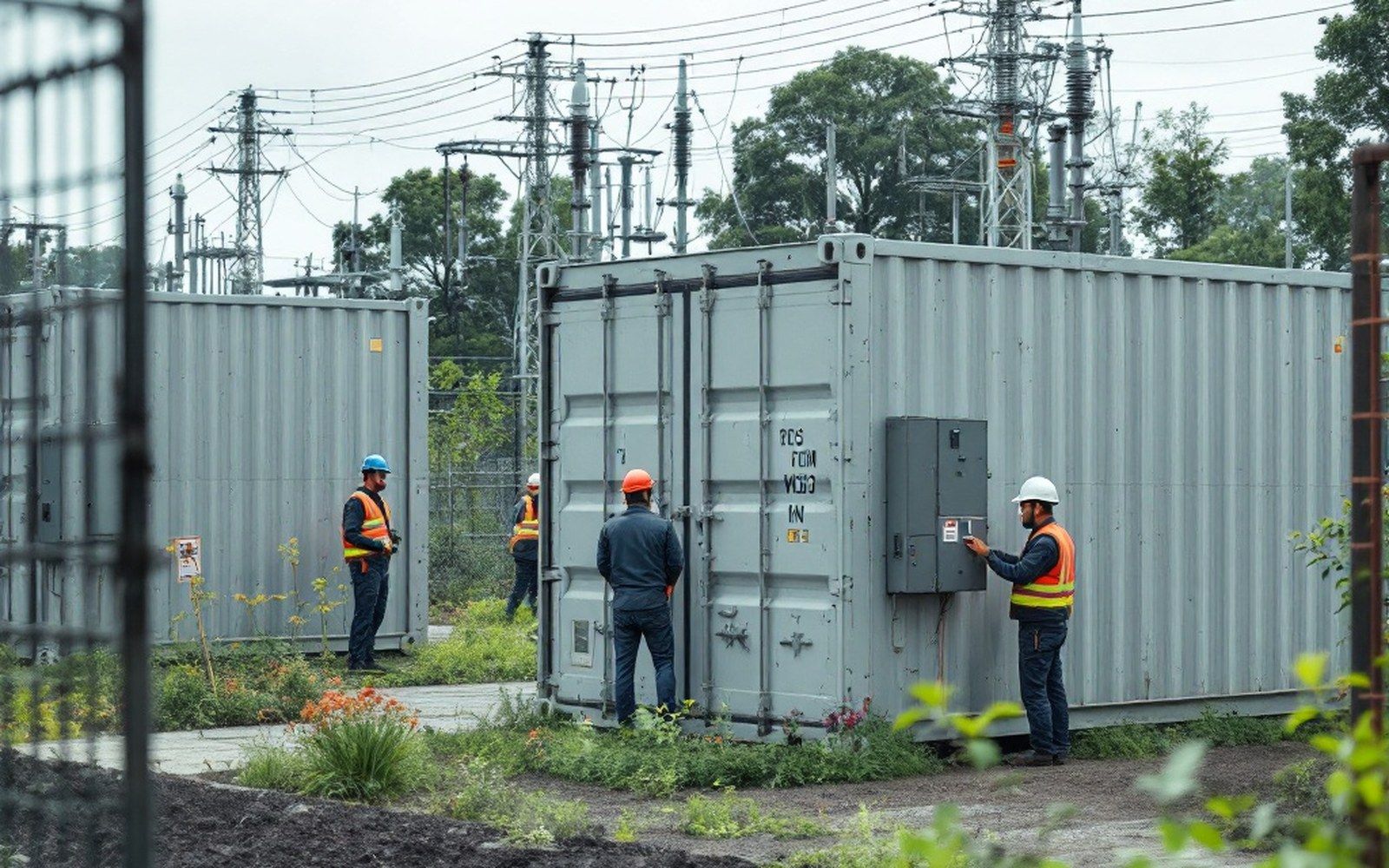
Drive past a grid-scale battery and you might miss it. The site is a fenced rectangle, usually on disturbed or industrial land, with rows of white or grey steel containers — each one roughly the size of a shipping container — sitting on a concrete pad. A transformer stands at one corner. A small control building houses the power conversion systems and communications gear. There is no chimney, no cooling tower, no feedstock arriving by truck. The visual signature is close to a rural substation.
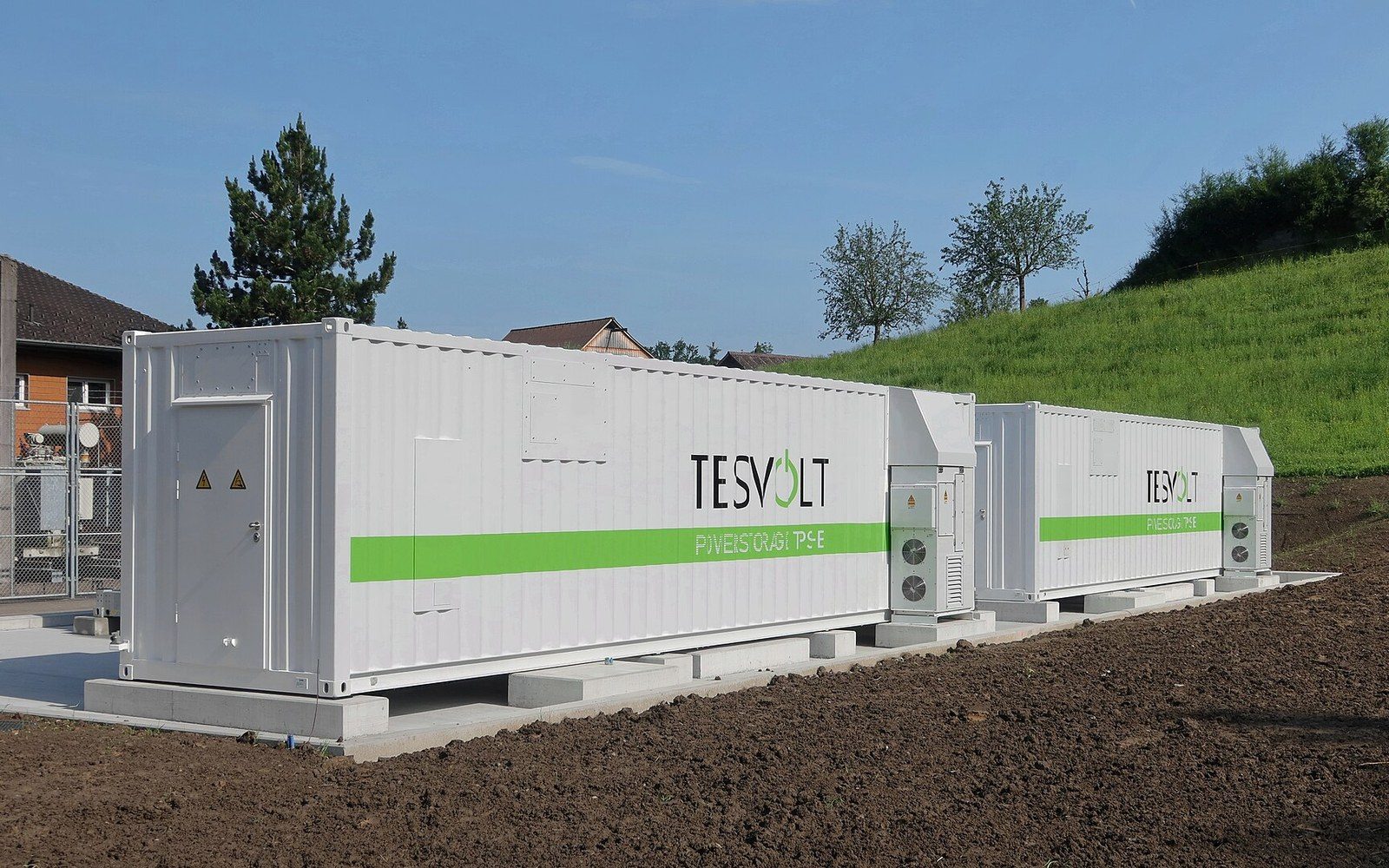
Inside each container, battery modules are racked floor-to-ceiling: in most installations built after 2020, lithium iron phosphate cells in prismatic format, chosen over nickel-manganese-cobalt chemistry for lower fire risk and longer cycle life. Thermal management — a mix of air and liquid cooling depending on the manufacturer — runs through the rack structure. Each container connects to a battery management system that monitors cell voltage and temperature at the module level and communicates upward to a site controller.
The containers themselves are shipped from the factory full of cells; they arrive as integrated units, pre-wired and pre-tested, which is why deployment timelines have compressed. A site that would have taken two years to build with conventional plant engineering can now be energised in months once the grid connection is ready. The grid connection is almost always the long lead item.
The site is chosen by the grid operator's needs, not by the developer's preference.
Where they end up
The site is chosen by the grid operator's needs, not by the developer's preference. A battery earns its living by responding to frequency deviations, shifting cheap overnight generation into peak evening hours, or providing the capacity credit that regulators require. All of those functions are grid functions, which means the asset has to be electrically close to where the grid needs it — near a substation with spare capacity on the interconnect, near a renewable generator with a curtailment problem, or at the end of a weak radial line that cannot handle the morning ramp without support.
Hornsdale Power Reserve in South Australia sits next to a wind farm and a transmission node, which is exactly why it was there in 2017 when frequency response became the defining use case. The site is in Jamestown, a small town of a few thousand people in the Mid North of the state — the kind of place nobody would put a generating asset unless the grid said so. Tesla built it in under 100 days, and Neoen operated it; the connection to Hornsdale Wind Farm determined the location as much as anything else.
That logic repeats everywhere. In Britain, large battery installations cluster in the Midlands and around London, not because the land is cheap but because the transmission constraints are real and the balancing revenues are highest there. In Texas, ERCOT's nodal pricing means a battery positioned at the right node can capture a spread that the same battery at the wrong node cannot, so site selection is a matter of market modelling as much as civil engineering. In California, batteries built after the 2020 rolling blackouts were placed in the LA Basin and the Bay Area because that is where the California ISO needed evening capacity, full stop.
The practical consequence is that grid-scale batteries have ended up on brownfield land, old industrial sites, the edges of quarries, and the margins of substations — wherever a 66 kV or 132 kV interconnect is reachable within a reasonable cable run. Planning authorities have generally found them easier than generation plant: no fuel deliveries, no noise beyond the hum of cooling fans, no stack. Objections tend to be about fire risk, which is real and which battery management systems and the growing body of fire suppression standards are designed to address.
The container yard is, in the end, a piece of power system infrastructure wearing the livery of logistics. Its geography is the grid's geography — invisible to the eye, but precise.