Not proven, and who says so
Direct air capture works at pilot scale. What it costs at the scale the climate requires is a number nobody agrees on, and the disagreement runs through the most serious technical institutions on earth.
What the machines actually do
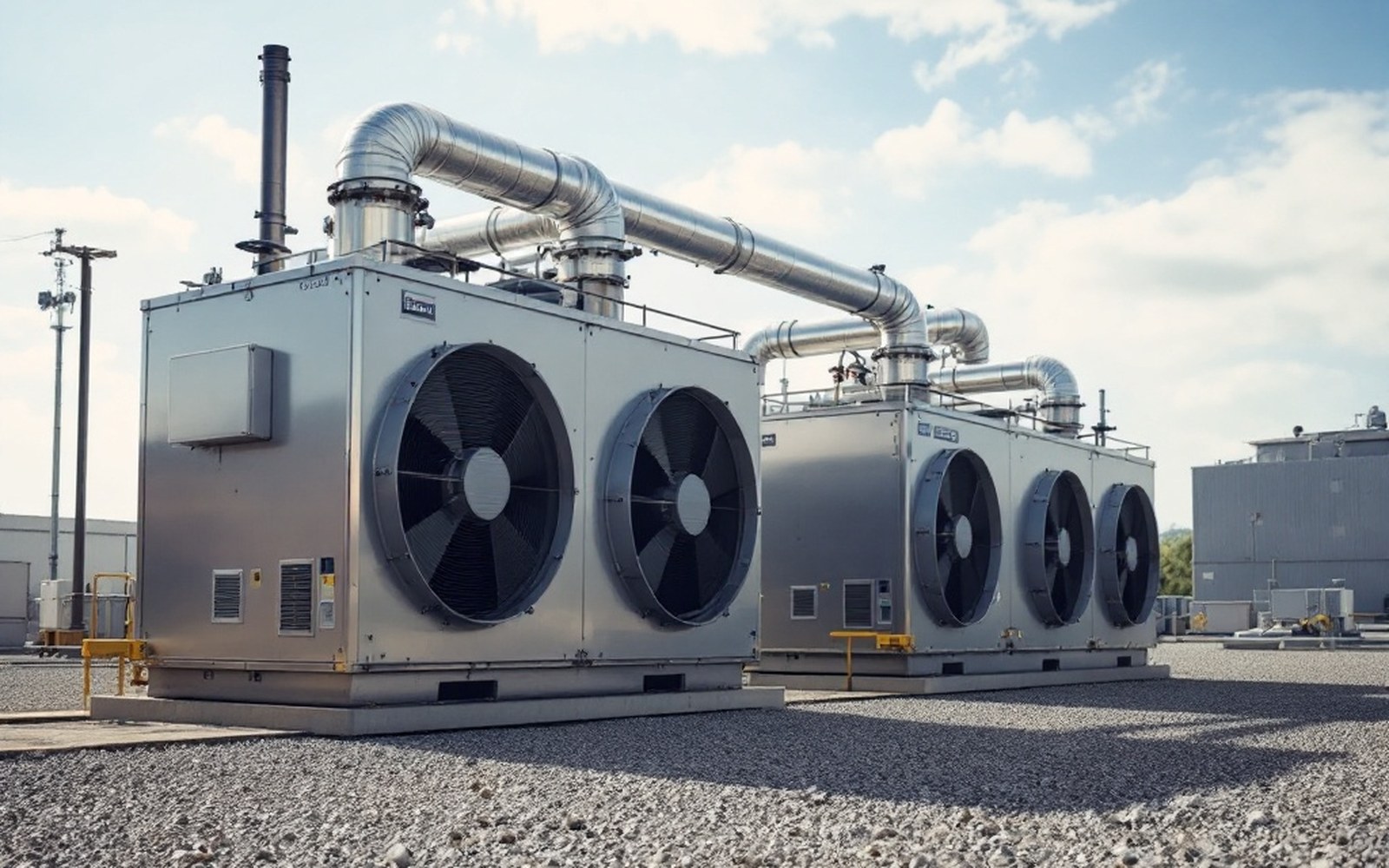
A direct air capture plant pulls ambient air across a solid or liquid sorbent, binds the carbon dioxide chemically, then releases it under heat or a pressure swing, producing a concentrated stream of CO₂ that can be compressed and injected underground or used in industrial processes. The chemistry is not exotic — both amine-based and potassium hydroxide systems have decades of industrial history in gas processing. The problem is the concentration: CO₂ in outdoor air sits at roughly 420 parts per million, compared with roughly three to fifteen percent in the flue gas of a power station. Chasing a dilute target through an enormous volume of air costs a great deal of energy and, consequently, money.
Two plants have so far crossed from demonstration into what their operators describe as commercial operation. Climeworks opened Mammoth in Iceland in 2024, rated at 36,000 tonnes of CO₂ per year — it sits beside the Hellisheidi geothermal plant, which provides the low-carbon heat and electricity the process needs. Carbon Engineering, now owned by Occidental, has operated a pilot in Squamish, British Columbia since 2015 and has a larger project under construction in Texas. Heirloom, using a mineralisation approach rather than amine sorbents, operates at smaller scale in California. Total nameplate capacity across all operating direct air capture projects worldwide remained below 0.01 million tonnes of CO₂ per year entering 2024 — a number the International Energy Agency's tracking of DAC deployment puts in sharp context against the hundreds of millions of tonnes some scenarios require by mid-century.
Where the cost estimates diverge
This is where sober institutions disagree, and disagree materially. Climeworks has reported costs in the range of several hundred dollars per tonne, with a stated ambition to reach below 300 dollars per tonne by 2030 through scale and learning. Carbon Engineering published an analysis in Joule in 2018 — peer reviewed, co-authored with David Keith of Harvard — estimating that a large plant could reach 94 to 232 dollars per tonne of CO₂. Independent reviewers at the time questioned the assumptions underlying the lower end of that range.
The dispute is not about whether direct air capture works chemically.
The National Renewable Energy Laboratory has modelled pathways to lower costs through learning curves and process integration, but the models are sensitive to input assumptions: the cost of low-carbon heat, the capacity factor of the plant, the capital intensity of the contactors. Lawrence Berkeley National Laboratory researchers have examined the energy penalty in detail; the figures are not small. A solid sorbent system requires roughly 5 to 10 gigajoules of thermal energy per tonne of CO₂ captured, depending on design and regeneration temperature, alongside one to two gigajoules of electricity. At current prices for green heat or electricity, those inputs alone push cost floors well above the lower end of Carbon Engineering's published range.
Fraunhofer ISE, the German applied-research institute, has published analyses noting that the learning-curve arguments familiar from solar — where every doubling of cumulative production cut the module price by roughly a fifth — do not straightforwardly transfer to direct air capture. Solar modules are manufactured goods: identical units produced on a line in high volume. A direct air capture plant is closer to a chemical plant: bespoke engineering, site-specific integration, and a process whose dominant cost is not hardware but the thermodynamic work of separating a dilute gas. The energy penalty does not shrink just because you build more plants.
IRENA has been careful in how it presents the technology, placing direct air capture in a category it labels "not yet commercially demonstrated at scale" while noting that costs remain highly uncertain. The IPCC's Sixth Assessment Report includes direct air capture in several mitigation scenarios but is explicit that current costs are high and that the technology has not been demonstrated at anything close to the scale those scenarios require. The Global CCS Institute, which advocates for carbon capture broadly, gives higher confidence intervals than some startup projections, noting that no plant has yet been built large enough to settle the engineering uncertainties.
What the disagreement is actually about
The dispute is not about whether direct air capture works chemically. It does, and the Mammoth plant in Iceland produces real tonnes of CO₂ that are monitored and verified. The dispute is about whether the cost trajectory will follow a steep learning curve, as solar and wind costs did, or whether it will flatten at a level that limits the technology's practical role.
Two structural questions underlie the argument. First, how much of the current cost is engineering novelty — first-of-kind plant premiums, conservative designs, expensive procurement — and how much is the irreducible thermodynamic floor? The thermodynamic minimum energy to separate CO₂ from air at current concentrations is set by physics, not engineering. What sits above that floor is the subject of genuine research at NREL, Lawrence Berkeley, and university groups in Europe and North America. Second, what is the opportunity cost of the energy? A direct air capture plant running on electricity uses electricity that could displace fossil fuels directly. At low capacity factors or on grids still partly fossil-powered, the net accounting gets complicated.
Operators and some analysts argue the technology is at the same stage solar was in the early 1990s — expensive, small, but on a curve that rewards investment. Sceptics, including researchers with no commercial position in the outcome, point out that the analogy requires the cost to be dominated by manufactured components that improve with volume, and that direct air capture's cost structure does not obviously fit that description. Neither camp has been proven right by evidence, because the scale of deployment needed to test the trajectory does not yet exist.
What exists is: a handful of working plants, costs that are currently measured in hundreds of dollars per tonne, a thermodynamic constraint that sets a floor, and a set of models whose conclusions depend heavily on assumptions that remain contested. The honest answer to "what will it cost at scale" is that the people best positioned to know disagree by a factor of three or more — and that the disagreement is itself useful information for anyone deciding how much weight to place on the technology in long-range planning.