Where it goes afterwards
The geology must earn the trust
Capturing carbon dioxide is the easier half of the problem. The harder half is deciding where it goes and ensuring it stays there. The physics of permanent storage depends on geology, not engineering, and geology is stubborn about its terms.
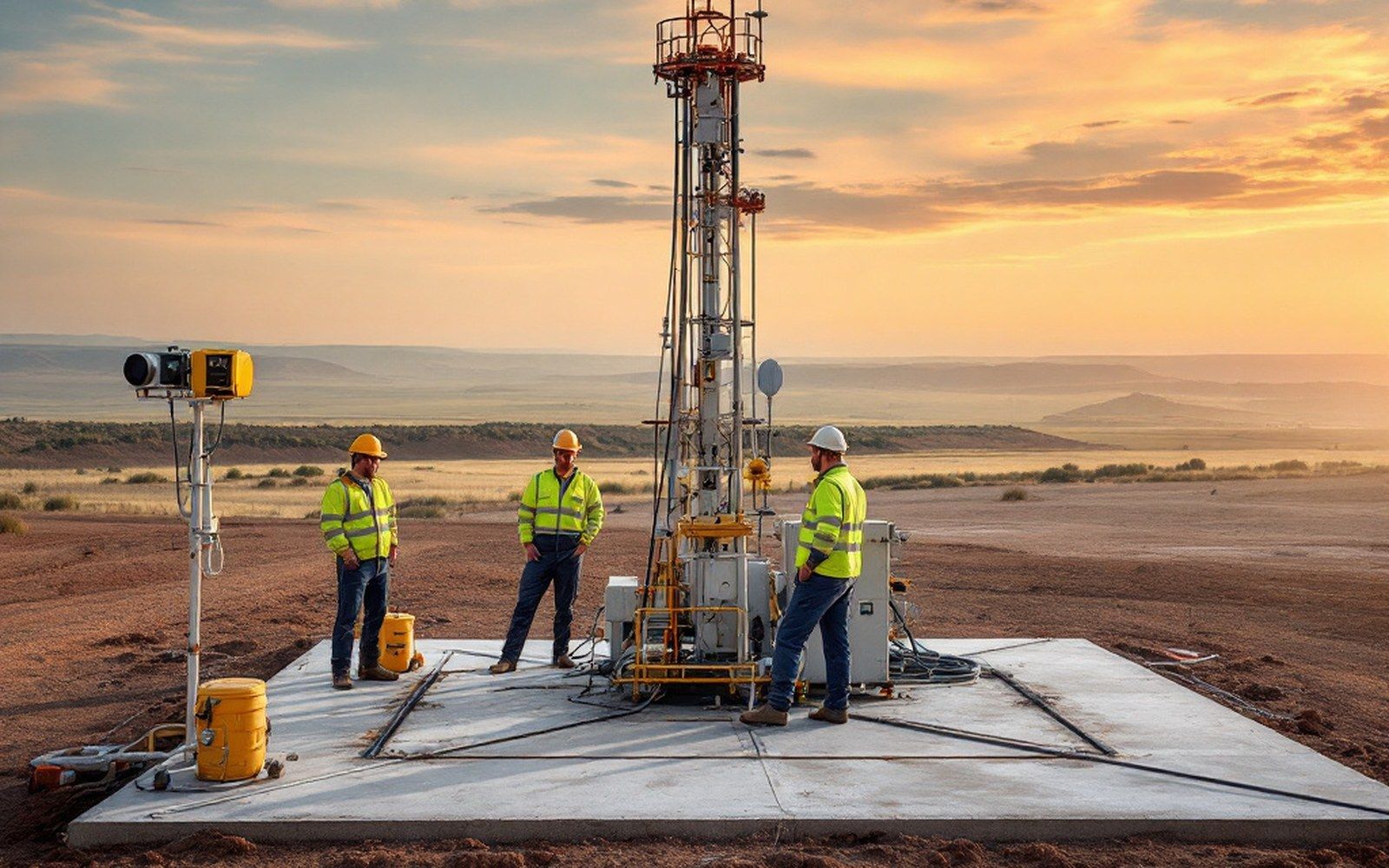
Almost all commercial CO₂ storage today uses deep saline aquifers — porous rock formations saturated with brine, sealed by an impermeable caprock, typically more than 800 metres underground. At that depth, pressure keeps CO₂ in a dense supercritical state, behaving more like a liquid than a gas, which reduces its tendency to migrate upward through the formation. The Sleipner project in the Norwegian North Sea, operated by Equinor since 1996, was the first industrial-scale example: around 17 million tonnes of CO₂ injected to date, drawn from a gas processing operation and stored in the Utsira sandstone formation beneath the seabed. Monitoring at Sleipner through seismic survey has shown the plume expanding predictably within its containment zone — the closest thing the field has to a long-term proof of concept.
Depleted oil and gas reservoirs are the other main option. They have known geometry, pressure history and — because they held hydrocarbons for millions of years — a demonstrated ability to retain buoyant fluids. Their disadvantage is location: they are where the oil was, not necessarily where the emissions are.
CO₂ stored geologically does not simply sit still.
What monitoring actually involves
Injection is not a set-and-forget operation. Regulatory frameworks require operators to monitor the subsurface plume for decades after a well is sealed, watching for pressure anomalies, unexpected migration or micro-seismic events that might signal caprock stress. The instruments used include passive seismic arrays, repeat 3D seismic surveys and wellbore pressure gauges. Satellite-based ground deformation measurement — InSAR — is increasingly standard for detecting surface uplift, a possible sign of overpressure.
The Global CCS Institute's 2023 status report counted 41 commercial-scale CCS facilities operating or in construction worldwide, with storage capacity of roughly 50 million tonnes per year. That is a large number in institutional terms and a small one in climate terms: global CO₂ emissions from energy and industry run above 37 billion tonnes annually. The gap between those two figures is what makes the "proven at scale" question genuinely contested.
The Otway Basin project in Victoria, Australia, run by CO₂CRC, has been one of the more carefully instrumented research sites, specifically designed to test whether small leakage volumes can be detected before they become significant. The answer so far is that they can — under the controlled conditions of a research well with known injection volume. What happens across a hundred commercial wells over a century is a different question.
What "permanent" means in practice
CO₂ stored geologically does not simply sit still. Over decades, it dissolves into brine; over centuries, it reacts with the surrounding rock to form carbonate minerals — a process called mineral trapping, which is considered the most durable form of storage. CarbFix, a project in Iceland at Hellisheidi, has demonstrated this mineral trapping in basalt at an accelerated rate: injected CO₂ mineralised within two years rather than the thousands normally estimated for sandstone. The rock type matters enormously, and basalt is not available everywhere.
Legal liability for stored CO₂ is the institutional problem that geology alone cannot solve. In most jurisdictions, responsibility transfers from the operator to the government after a post-closure monitoring period — typically 20 to 50 years — though the CO₂ may be geologically mobile for much longer. What happens if a storage site leaks in 2180, under a regulatory framework that did not exist when the well was drilled in 2035, is not yet answered by any country's law. Norway has gone furthest in building a legal transfer mechanism through its North Sea regulatory regime, but even there the post-transfer liability question is formally open.
The permanence that geological storage requires is measured in millennia. The monitoring and legal infrastructure humans have built to manage it is measured in decades. Both facts belong in the same sentence when the technology is being assessed, and neither one cancels the other out.