The electric arc route
Steel made from scrap in an electric arc furnace is genuinely low-carbon — and the ceiling on how much steel the world can make this way is set by how much scrap exists.
What the furnace actually does
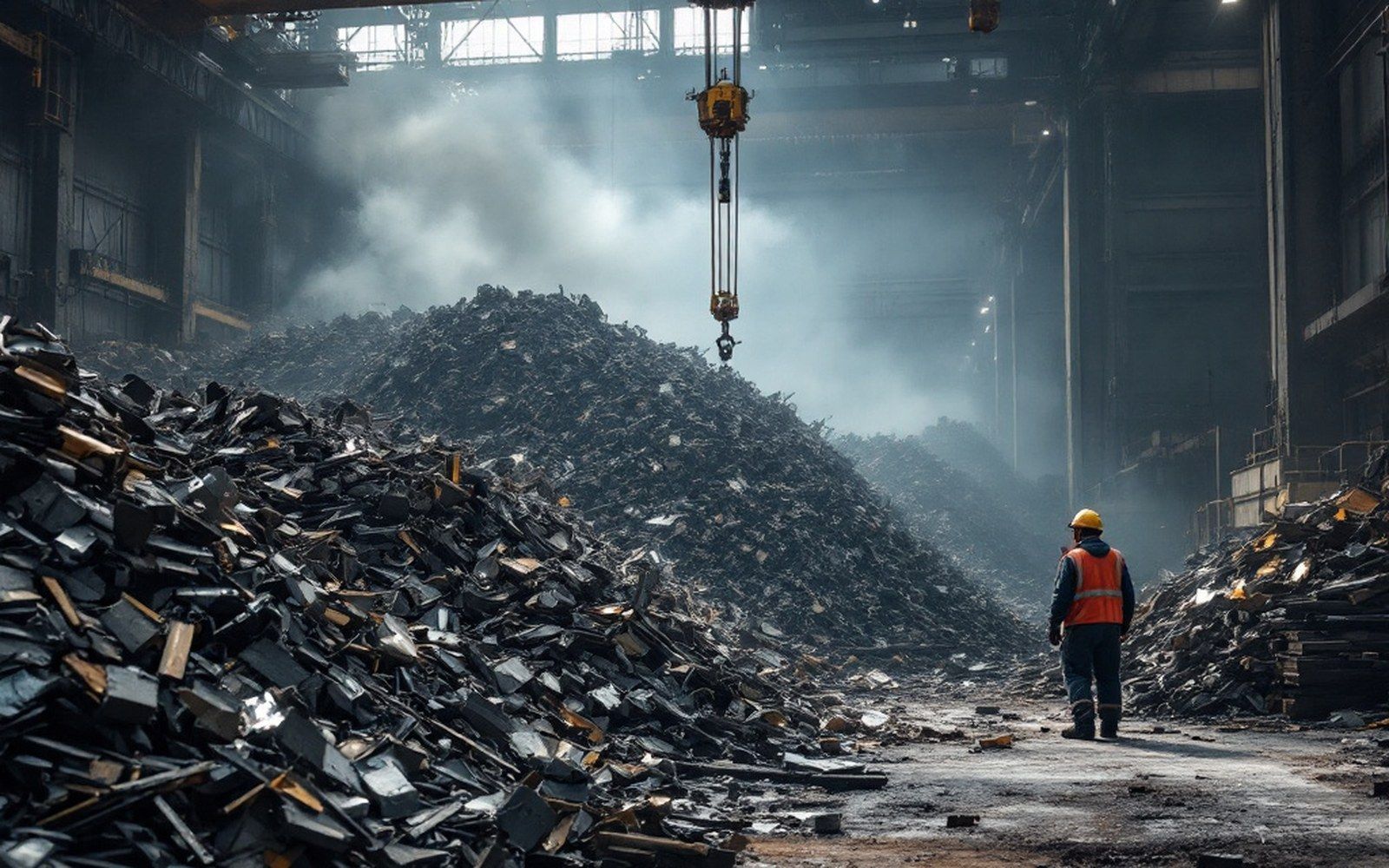
An electric arc furnace is a large refractory-lined vessel, typically holding between 60 and 400 tonnes of charge, that melts steel scrap by passing enormous electrical current through carbon electrodes and arcing it directly into the metal. The arc temperature exceeds 3,000 °C. The whole heat — industry language for a single batch — takes roughly 40 to 90 minutes from cold charge to tapped liquid steel. No iron ore, no coking coal, no blast furnace. The carbon dioxide that escapes comes mainly from the electrodes themselves and from whatever fossil fuel is used to trim temperature; if the electricity is clean, the emissions per tonne of steel drop to a small fraction of the blast furnace route.
That fraction matters. The integrated blast furnace–basic oxygen furnace route, which starts from iron ore, emits roughly 1.8–2.1 tonnes of CO₂ per tonne of steel under typical operating conditions. The electric arc route, on grid-average electricity, runs closer to 0.4–0.6 tonnesof CO₂ per tonne of steel, and on clean power it falls further still. Electric arc furnaces already account for about 28 percent of global steel output, concentrated heavily in the United States — where the share exceeds 70 percent — and in Italy, Spain and Turkey, all of which built arc capacity around locally collected scrap rather than domestic iron ore.
The scrap constraint
The limiting input is not electricity. It is the scrap itself. Steel is extraordinarily durable and most steel ever made is still in use — in buildings, bridges, vehicles and machinery that have not yet reached end of life. Global scrap availability is therefore a function of how much steel was produced and used decades ago, and then discarded. The world's steel stock is still accumulating in fast-growing economies; the scrap it will eventually release is mostly still standing.
This is the hard ceiling the technology runs into.
The International Energy Agency estimates that even in ambitious scenarios, the electric arc share of global production cannot exceed roughly 45–50 percent by 2050, simply because there will not be enough high-quality scrap to feed more furnaces than that. Scrap is also not uniform: contaminated scrap — carrying copper, tin or tramp elements from mixed-metal products — degrades the quality of the steel produced and limits the grades an arc furnace can reach without diluting with direct reduced iron.
This is the hard ceiling the technology runs into. It is not a technical failure; the furnaces work reliably at scale. Nucor in the United States, which operates entirely on the arc route, has run arc steelmaking profitably through multiple market cycles. The constraint is geological and temporal: the steel stock deposited in the built environment will release its scrap on a schedule that no policy instrument meaningfully accelerates.
Where arc furnaces sit in the wider picture
The route from iron ore using hydrogen — reducing iron without carbon, then feeding the resulting direct reduced iron into an arc furnace — is the path that can go beyond the scrap ceiling. But that depends on hydrogen at scale and cost, and it is not yet operating commercially at significant volume. The arc furnace on scrap, by contrast, is deployed, profitable and expanding.
Fraunhofer ISE and Lawrence Berkeley National Laboratory have both published work on the electricity demand profiles of arc steelmaking, relevant to grid planning: because a heat takes under two hours and furnaces can be scheduled, arc steel mills are credible candidates for demand-side flexibility. A large mill drawing 100–150 MW for 60 minutes, then idle for 30, is a load that can be shifted by agreement with grid operators. A steel town with multiple furnaces offers meaningful flexibility without any new storage infrastructure.
The electric arc route, then, is real and scaled, not a demonstration project or a paper commitment. Its emissions performance is good; its growth is constrained by scrap supply rather than technology readiness. The question the steel industry faces is not whether arc furnaces work, but whether enough of them can run on clean electricity while the longer hydrogen-based route reaches commercial readiness.