The cold end
A heat pump's output peaks in mild weather and troughs in a hard frost — and bridging that gap is where the engineering lives.

The physics of the cold end
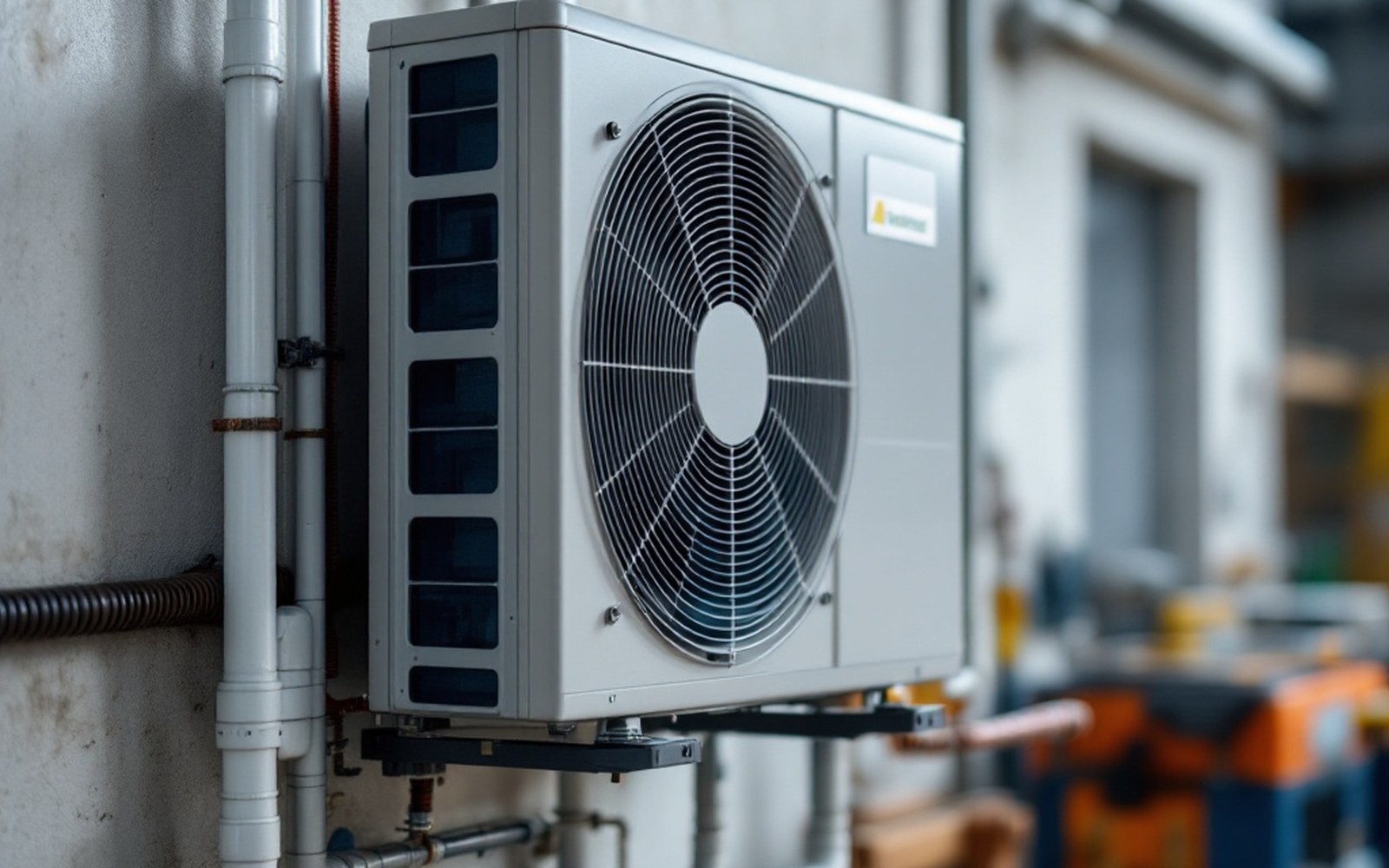
A heat pump extracts heat from a low-temperature source — usually outdoor air — and delivers it at a higher temperature inside. The ratio of heat delivered to electricity consumed is the coefficient of performance: a COP of 3 means three units of heat for one of electricity. That ratio is not fixed. It is governed by the temperature difference the refrigerant cycle must bridge. Narrow the gap and the COP rises; widen it and the COP falls. In a mild autumn, an air-source unit running between 7 °C outside and 35 °C at the emitter might achieve a COP above 4. At −10 °C outside, bridging nearly 45 degrees, the same machine might manage 1.8 — barely better than a resistance heater.
This is not a design flaw. It is Carnot's limit, and no refrigerant cycle escapes it. The Carnot coefficient of performance for a heat pump is T_hot divided by (T_hot minus T_cold), in absolute temperatures. Real machines never reach the theoretical maximum, but they track it: as the cold reservoir gets colder, the ceiling falls, and so does the actual output.
The problem is timing. Cold snaps — the days when outdoor temperatures fall hardest — are precisely the days when heating demand peaks. An air-source heat pump sized for typical winter conditions may cover, say, 98 % of annual heating hours but run short during the coldest 1–2 % of the year, when its capacity is lowest and the building's losses are highest. Engineers call this the design point mismatch, and every European cold-climate installation must confront it.
How the industry handles it
The standard commercial answer is a bivalent system: the heat pump handles most of the load, and a backup — a gas boiler, an oil burner, or an electric resistance element — covers the gap below some outdoor cut-off temperature, typically between −5 °C and −15 °C depending on climate. Below that threshold, the backup carries the full load. Above it, the heat pump takes over. Sizing the heat pump for peak demand would require a much larger, more expensive compressor that runs at part-load for most of its life, which is wasteful on capital and efficiency grounds.
The honest framing is this: air-source heat pumps are weather-dependent machines.
A more elegant answer is the cold-climate heat pump (CCHP), a category that emerged commercially in the 2010s through advances in variable-speed compressors — inverter-driven units that modulate speed rather than cycling on and off — and in refrigerant selection. Units using R-32 or R-454B can maintain usable heating capacity down to −25 °C or colder. Fraunhofer ISE and the National Renewable Energy Laboratory have both published field-performance data showing that modern cold-climate units in Scandinavian and Canadian conditions sustain COPs of 1.5 to 2.5 at outdoor temperatures of −15 °C to −20 °C — a meaningful improvement over earlier generations.

Ground-source heat pumps sidestep the problem entirely by drawing from soil or groundwater at depths where winter temperatures are relatively stable: typically 8–12 °C in temperate climates, regardless of air temperature above. The seasonal swing in source temperature is small, so the COP is more consistent — and the design-point mismatch largely disappears. The trade-off is drilling cost and site constraints.
In places like Boden, in northern Sweden, where district heating networks already exist, large-scale heat pump installations draw from river water or sewage effluent, both of which stay above zero even in deep winter. Here the cold-end problem is managed by the thermal mass of the water body rather than by a backup fossil burner.
The honest framing is this: air-source heat pumps are weather-dependent machines. That is not a reason to exclude them — their average seasonal performance across a whole heating year is substantially better than resistance heating — but it does mean that peak-load cover must be designed in deliberately. The COP at the worst hour is never the COP in the brochure, and the difference between those two numbers is where the engineering argument actually lives.